Do People Use ChatGPT Instead of Google? What the 2026 Data Shows
No — most people haven't swapped Google for ChatGPT. But the 2026 data shows which searches are moving to AI fastest: the buying research that used to convert.
No, most people have not swapped Google for ChatGPT. Google still handles the overwhelming majority of search (91.31% of the global search engine market in July 2026, per StatCounter), and 95% of ChatGPT’s users also used Google in the same three-month window (Similarweb, 2026). What has changed is which questions go where: buying research (comparisons, shortlists, “which vendor should we pick”) is moving to AI assistants fastest, and that is the slice of search that used to deliver customers.
“Is ChatGPT killing Google?” is the wrong question, because the answer is no and it leaves you complacent. The useful question is narrower: when someone is about to spend money on what you sell, where do they ask now? Every figure below carries a named source you can check.How many people use ChatGPT, and how does that compare with Google?
Two definitions first, because the companies count differently and headlines blur them. Weekly active users means unique people who used a product at least once in seven days. Queries, or prompts, means individual things typed in. One user generates many prompts, so the two numbers are never interchangeable.
What’s being measured | Latest figure | Source and date |
|---|---|---|
People reached by OpenAI’s models (all its interfaces, not ChatGPT alone) | More than 1 billion active users; more than 2 million businesses | OpenAI, 31 July 2026 |
ChatGPT weekly active users (last figure stated as such) | 900 million | OpenAI, 27 February 2026 |
ChatGPT prompts per day | More than 2.5 billion globally, about 330 million from the US | OpenAI, reported by Axios, July 2025 |
Google searches per year | More than 5 trillion (just under 14 billion a day) | Google blog, May 2025, citing Google internal data from January 2025 |
Google’s share of the search engine market | 91.31% worldwide | StatCounter, July 2026 |
Google AI Mode monthly active users | More than 1 billion | Alphabet Q2 2026 results, 22 July 2026 |
Gemini app monthly active users | 950 million | Alphabet Q2 2026 results, 22 July 2026 |
Why you should not do the division
Divide 2.5 billion prompts by roughly 14 billion searches and you get “18% of search.” Don’t. Those two figures were published a year apart. They also measure different actions, and a prompt inside a long conversation is nothing like a one-line query. OpenAI’s billion-user figure covers all its interfaces, not ChatGPT alone.
The table establishes the only thing you need: this is mainstream behaviour with an audience in the hundreds of millions, while Google remains the larger surface by a wide margin.
Is ChatGPT replacing Google, or layering on top of it?
Layering on top, on the evidence. Similarweb’s 2026 Generative AI Landscape report tracked audience overlap between March and May 2026. Of ChatGPT’s 494 million users, 461 million (95%) also used Google in the same window. Across the category, generative AI sites averaged 9.5 billion monthly visits in the year to May 2026, up 70% year on year, with 655 million monthly unique visitors. Google drew around 3.3 billion, roughly five times the whole chatbot category combined.
Pew Research Center’s survey of 5,119 US adults, fielded in February 2026, points the same way. Half of US adults (49%) now use AI chatbots, up from 33% in August 2024. Pew notes the question was worded differently before 2026, so treat that trend as directional. ChatGPT reaches 44% of adults. Some 42% of all US adults use chatbots to search for information, and 60% read the AI summaries at the top of search results. The same report carries the other half of the story: about half of US adults never use a chatbot, and roughly a quarter use one daily.
That summaries figure matters more than most business owners realise. Much of “AI search” is not happening on a separate website. It is happening inside Google. AI Mode passed a billion monthly active users after its global rollout, and Sundar Pichai told investors it is driving an incremental increase in overall search queries (Alphabet, July 2026). This is not migration. It is the same people using more surfaces, with an answer layer in front of the links. For what that changes in the work, see our breakdown of GEO versus traditional SEO.
Which kinds of questions are moving to AI first?
Not all of them, and not evenly. “How People Use ChatGPT” classified a representative sample of ChatGPT conversations from November 2022 to July 2025. It was written by OpenAI researchers with Harvard economist David Deming, and circulated as NBER Working Paper 34255 in September 2025. Three categories accounted for nearly 80% of all conversations: practical guidance, seeking information, and writing. Non-work messages grew from 53% to more than 70% of usage over that period.
The pattern is obvious once you read it as a business owner. “Practical guidance” and “seeking information” are what buying research looks like before anyone types a brand name. Which CRM suits a 20-person agency? What should commercial cleaning in Gurgaon cost? Those questions never produced a homepage click anyway. They produced a shortlist, and the shortlist step is what has moved.
Segment | What the 2026 evidence shows | Source |
|---|---|---|
B2B software buyers | 51% start research with AI chatbots more often than with Google, up from 29% in April 2025 | G2, April 2026 (1,076 decision-makers) |
Consumers who already use AI for shopping | 46% begin purchase research on a stand-alone AI platform versus 24% on traditional search, a reversal of 25%/43% in 2024 | L.E.K. Consulting, July 2026 (2,650 US consumers) |
All US adults | 49% use AI chatbots; 42% of all US adults use them to search for information, but about half never use one | Pew Research Center, June 2026 (5,119 adults) |
Whole-web referral traffic | AI traffic grew 66% during 2025 but still made up under 0.15% of total visits | Semrush, April 2026 (50,000+ sites) |
The last row is the counterweight that keeps the others honest.
The denominator trap
The L.E.K. figure is the one most often mangled online. It is 46% of consumers who already use AI for shopping, not 46% of all consumers. L.E.K. puts overall adoption at roughly 30% of US consumers having used AI to inform a purchase. Whenever you see an eye-watering AI adoption stat, ask: adoption among whom?
Are buyers actually choosing vendors this way?
This is where the data stops being interesting and starts being expensive. G2’s “The Answer Economy,” published April 2026, surveyed 1,076 B2B decision-makers across North America, EMEA and APAC in March 2026. Beyond the 51% headline, 71% rely on AI chatbots for software research. Another 69% chose a different vendor than they had originally planned, based on what the chatbot told them, and 33% bought from a vendor they had not previously heard of.
The study supplies its own qualifier: 45% said citations from software review sites were the most confidence-inspiring signal in an AI answer. The chatbot is persuasive largely because of who it quotes.
A third of buyers bought from a company they had never heard of before the conversation. That is not a traffic story. It is a shortlist story. If you sell software or B2B services, our GEO playbook for SaaS and B2B covers how those shortlists get assembled.
On the consumer side, L.E.K.’s April 2026 survey found comparing options and narrowing a shortlist together account for 53% of primary AI use, ahead of final decision-making (21%) and discovery (19%). Thirty-one percent said their decision was largely made before they reached a brand or retailer site, up from 26% in 2024. Only 8% bought entirely through an AI agent, and 94% still checked AI output before buying. The click still matters, but it comes later, with most of the decision already made.
What happens to the traffic AI does send?
Small in volume, unusually good in quality. Two terms are worth pinning down. Referral traffic is a visit that arrives from a link inside an AI answer, and zero-click describes a search answered without anyone visiting a website.
Most AI answers are zero-click. Similarweb found only 6.8% of ChatGPT answers included an external link as of May 2026. That is a more than fivefold rise from roughly 1% a year earlier, but it still means about 93 in every 100 answers send no traffic anywhere. Pew’s browsing study covered 900 US adults across 68,879 Google searches in March 2025. Where an AI summary appeared, people clicked a traditional search result in 8% of visits, against 15% where none appeared. They clicked a link inside the summary in just 1% of visits. An AI summary appeared on about 18% of the searches Pew tracked.
The clicks that do come through behave differently. Adobe Analytics, drawing on more than a trillion visits to US retail sites, reported that AI-driven retail traffic in May 2026 was up 138% year on year. AI-referred visitors converted 54% better than non-AI traffic, a reversal from the year before, when they converted at nearly half the rate. They spent 53% more time on site, viewed 23% more pages and were 36% less likely to bounce straight off. Semrush’s July 2025 study of 500+ topics put the average AI search visitor at 4.4 times the value of an organic one, on conversion rate.
The mechanism is simple: the AI did the comparison shopping, so the visitor arrives having already weighed you against the alternatives.
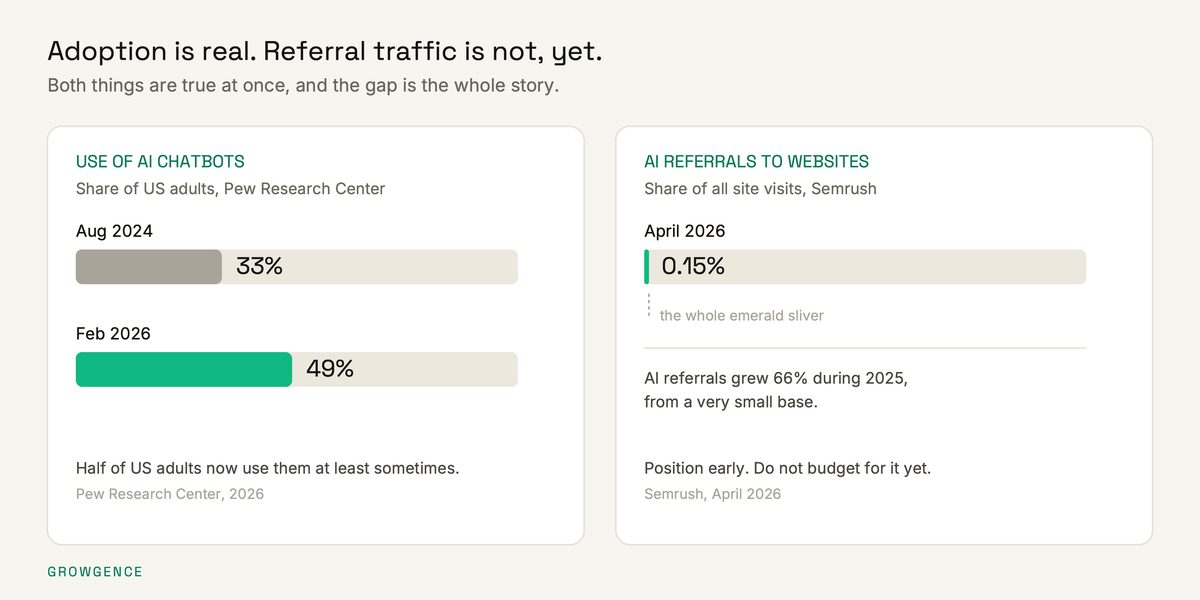
Adoption of AI chatbots among US adults rose from 33% in August 2024 to 49% in February 2026 (Pew Research Center, 2026). AI referrals were still only 0.15% of all site visits in April 2026, having grown 66% during 2025 from a very small base (Semrush, 2026).
What is the honest answer on how urgent this is?
This is a compounding problem, not an emergency, and anyone telling you otherwise is selling something. Five things the numbers do not support.
First, this is not a traffic channel yet. Under 0.15% of total web visits (Semrush, April 2026) is a rounding error for most businesses. Organic search still generated over a trillion visits across the sites Semrush studied and remained dominant, though it slipped in 13 of 17 industries.
Second, the conversion numbers are narrower than they sound. Adobe’s figures are US retail; Semrush’s 4.4x came from marketing and SEO topics. Different methods produce different multiples, and the reason AI visitors convert well, that they arrive late in the buying cycle, also makes them a small and self-selecting group. The effect is real, but it is not a promise about your business.
Third, projections are projections. Semrush’s estimate that AI search could send more visitors than traditional search by 2028 was made in July 2025, about a specific set of digital marketing and SEO topics. The authors flag it as an extrapolation, so treat it as a direction, not a date.
Fourth, nobody can guarantee you a place in an AI answer. There is no ranking dashboard, no submission form, no rank-one guarantee. Answers vary by user, phrasing, session and model version. You can measure your presence across a fixed set of buyer questions and track whether it improves. That is all.
Fifth, the boring stuff bites first. Since July 2025, Cloudflare has asked every new domain at sign-up whether to allow AI crawlers, blocking them by default under a permission-based model (Cloudflare, 1 July 2025). Plenty of sites are invisible to AI assistants for no reason more dramatic than a bot setting nobody revisited.
So the realistic frame is this: a growing share of buying research now begins here. The cost of being present is mostly work you should be doing anyway. The cost of being absent shows up quietly — as deals that never reach your pipeline, because you were never on the shortlist.
What should your business actually do about it?
Six steps, roughly in that order.
- Find out what AI says about you now. Take ten questions a buyer would ask before choosing you: “best [your category] in [your city]”, “[competitor] alternatives”, “is [your company] any good”. Run them in ChatGPT, Gemini and Perplexity, and record whether you are named, cited or absent. Our AI visibility audit framework sets out how to do it repeatably.
- Confirm AI crawlers can reach you. Check robots.txt and your CDN’s bot rules. Blocking has become a common default at the CDN layer, and it is easy to miss.
- Publish what the comparison step needs. If comparing and shortlisting is half of what AI users do, the pages that get you into answers are pricing, alternatives, “best X for Y” and honest limitations. Brand adjectives rarely make it into an answer.
- Get mentioned where AI reads. Assistants lean on outside sources far more than your own copy, and G2’s buyers said review-site citations were what made them trust an answer. Digital PR for AI citations is the practical version.
- Make your identity machine-legible. Keep the name, address, category and descriptions consistent across the web, and add structured data, so an AI system knows what you sell.
- Measure it as a channel. Segment AI referrers in your analytics now, while volume is small, so you can see the trend rather than argue about it later.
None of that requires abandoning search. Google is still 91% of the market, and Pichai told investors Google is “now sending billions of clicks to websites every week through AI features in Search.” This is additive work, not a pivot.
Keep reading
- What is LLM SEO? How to get cited by ChatGPT, Gemini and Perplexity. Why some brands get named and others don’t.
- How to rank in Google AI Overviews. Where most “AI search” actually happens.
- What is share of model?. Turning AI visibility into a number you can track.
Sources
- OpenAI on 1bn+ active users, 31 July 2026, via AFP — https://www.cp24.com/news/world/2026/07/31/openai-says-has-more-than-1-billion-active-users/
- TechCrunch, 27 February 2026 — https://techcrunch.com/2026/02/27/chatgpt-reaches-900m-weekly-active-users
- TechCrunch, 21 July 2025 — https://techcrunch.com/2025/07/21/chatgpt-users-send-2-5-billion-prompts-a-day/
- Google blog, 21 May 2025 — https://blog.google/products/ads-commerce/google-search-ai-brand-discovery/
- StatCounter Global Stats, July 2026 — https://gs.statcounter.com/search-engine-market-share
- Alphabet, Q2 2026 results, 22 July 2026 — https://blog.google/company-news/inside-google/message-ceo/alphabet-earnings-q2-2026/
- Pew Research Center, 17 June 2026 — https://www.pewresearch.org/internet/2026/06/17/americans-and-ai-2026-chatbots-smart-devices-and-views-on-impact/
- Pew Research Center, full report and topline PDF — https://www.pewresearch.org/wp-content/uploads/sites/20/2026/06/PI\_2026.06.17\_Americans-and-AI\_REPORT.pdf
- Pew Research Center, 22 July 2025 — https://www.pewresearch.org/short-reads/2025/07/22/google-users-are-less-likely-to-click-on-links-when-an-ai-summary-appears-in-the-results/
- Chatterji et al., NBER Working Paper 34255, September 2025 — https://www.nber.org/papers/w34255
- Similarweb via Search Engine Journal, 30 July 2026 — https://www.searchenginejournal.com/ai-search-isnt-replacing-google-its-layering-on-top-similarweb-data/583378/
- Similarweb via TNW, 31 July 2026 — https://thenextweb.com/news/similarweb-2026-generative-ai-landscape-ai-search-fragmentation
- G2, 15 April 2026 — https://www.prnewswire.com/news-releases/new-g2-research-half-of-b2b-software-buyers-now-start-their-research-with-ai-chatbots-302742807.html
- L.E.K. Consulting, 13 July 2026 — https://www.lek.com/insights/consumer-products/thanks-ai-consumers-are-arriving-brand-and-retailer-sites-ready-buy
- Adobe Analytics via Digital Commerce 360, 17 June 2026 — https://www.digitalcommerce360.com/2026/06/17/adobe-ai-referred-traffic-to-retail-sites-doubles-in-a-year/
- Adobe Analytics via MarketingTech — https://www.marketingtechnews.net/news/ai-referrals-ecommerce-traffic-conversions/
- Semrush, 27 April 2026 — https://www.semrush.com/blog/traffic-channel-mix-study/
- Semrush, 21 July 2025 — https://www.semrush.com/blog/ai-search-seo-traffic-study/
- Cloudflare, 1 July 2025 — https://www.cloudflare.com/press/press-releases/2025/cloudflare-just-changed-how-ai-crawlers-scrape-the-internet-at-large/
Is your brand showing up when buyers ask AI?
Most businesses have never checked, and the answer is rarely what they assume. We will run a free AI visibility audit across the questions your buyers actually ask, and show you where you appear, where a competitor appears instead, and why.