How AI Search Affects Your Small Business in 2026 (And What to Do First)
AI search changes where buyers ask questions and shrinks how many businesses get named in the answer. Here is what that means for small businesses, and what to do first.
AI search affects your small business by changing where buyers ask their questions and, more importantly, by shrinking how many businesses get named in the answer. A page of Google results gave a buyer ten options to weigh. An AI answer hands them a short list of named businesses, and if you are not on that list, you are not in the conversation at all.
## What does “AI search” actually mean for a business owner?Two very different things get called “AI for small business,” and the confusion costs owners money.
The first is using AI: ChatGPT writing your emails, an AI tool doing your bookkeeping. Almost every article you will find covers this.
The second is being found by AI. A customer types “best physiotherapist near Andheri” or “reliable CRM for a 12-person sales team” into ChatGPT, Google’s AI Mode, Gemini, Perplexity or Copilot. The tool writes back a paragraph naming two or three or five businesses. That paragraph is now the shortlist. The industry calls the work of getting into it generative engine optimisation (GEO), LLM SEO, or plainly, AI visibility. If you want the mechanics of how citation actually works inside these tools, we covered that in what LLM SEO is and how to get cited.
This post is entirely about the second thing.
Why the two get confused
Because the same product does both. The tool your operations manager uses to summarise invoices is the tool your customer uses to pick a supplier. Owners hear “AI” and file it under internal efficiency, while the demand-side change happens in the same app.
Has buyer behaviour really changed, or is this just hype?
The behaviour change is measurable, and the numbers are no longer marginal.
OpenAI announced in February 2026 that ChatGPT had passed 900 million weekly active users, up from 800 million reported in October 2025 (OpenAI, reported by TechCrunch, 2026). On Alphabet’s Q2 2026 earnings call, Sundar Pichai said that since expanding AI Mode globally, Google had “surpassed 1 billion monthly active users.” He put the Gemini app at 950 million monthly active users (Google, 2026).
Scale alone does not prove buying behaviour. What people say they use it for is the better test:
- 45% of US consumers reported using AI for local business recommendations in the past year, up from 6% a year earlier. AI now ranks as the third most popular source of business recommendations, behind Google and Facebook. ChatGPT specifically was used by 31% of consumers and Google AI Mode by 23% (BrightLocal, Local Consumer Review Survey 2026, n=1,002 US adults).
- Among 30–44 year olds, often the people with budget authority, 64% had asked AI for a business recommendation (BrightLocal, 2026).
- A separate August 2025 survey of 1,000+ US consumers found that 48% had interacted with a conversational AI tool while researching local businesses, and 55% had consulted Google’s or Bing’s AI summaries (GatherUp, Beyond The Stars 2025).
And the answer increasingly ends the journey rather than starting it. Pew Research Center tracked the actual browsing of 900 US adults across 68,879 Google searches in March 2025. When an AI summary appeared, users clicked a traditional result on 8% of visits, versus 15% when no summary appeared. Clicks on the links cited inside the AI summary happened on just 1% of visits (Pew Research Center, 2025).
Read that last number carefully: being cited in an AI answer is often worth a mention rather than a click. Which is exactly why the mention matters.
Why does one AI answer hurt more than ten blue links?
Because ten links is a menu and one answer is a recommendation.
On a traditional results page, roughly ten businesses got a shot at the customer’s attention, plus a map pack, plus ads. Ranking fourth was worse than ranking first, but fourth still existed. An AI answer collapses that into a handful of named options, and everyone else is simply absent. Not ranked lower. Absent.
The evidence for this compression is now direct. A May 2026 study ran 1,120 searches across seven service verticals in 13 US cities and compared Google’s Local Pack against Google’s AI Mode for the same queries. It found that 28.5% of the businesses appearing in the Local Pack were missing from AI Mode (Local SEO Data, 2026). Roughly three in ten businesses that had earned local visibility the old way did not carry over. The same dataset also found 999 businesses in AI Mode that never appeared in the Local Pack: the list is not merely shorter, it is drawn differently.
Concentration shows up at brand level too. Semrush’s expanded 2026 AI Visibility Index analysed 126 million US AI search prompts from January to April 2026 across ChatGPT, Gemini, Google AI Mode and AI Overviews. In news and media, the top three brands accounted for 82.9% of visibility; in consumer electronics, 76.9%. Even in less concentrated sectors like finance (41.4%) and industrial (42.2%), three names take a large share of every answer generated (Semrush, 2026).
The winner-take-most problem in plain terms
The same study found ChatGPT averaged about 15 sources per response and Gemini about 3 (Semrush, 2026). Whatever the number on a given day, the shape is consistent: fewer slots than a results page.
Does a position, once won, stay won? That part is reasoning, not a finding. Concentration this tight suggests incumbents are hard to dislodge, which would make an early seat cheap and a late one expensive. But the durability evidence is thin. The same Semrush index found only 36 global brands held top-100 visibility across all four platforms for the whole January-to-April window. Treat “get in early because it sticks” as a working assumption, not a proven law. What is not in doubt is that there are fewer seats. We unpack what actually changes between the two disciplines in GEO vs traditional SEO.
Which small businesses feel this first?
Some of this is measured. Some of it is reasoning. We flag which is which.
Retail and e-commerce: measured
Traffic from AI sources to US retail sites grew 393% year over year in Q1 2026, based on Adobe Analytics data covering over a trillion visits to US retail sites. In March 2026, AI-sourced traffic converted 42% better than non-AI traffic. That is a reversal from March 2025, when it converted 38% worse (Adobe Analytics, reported by TechCrunch, 2026).
Local service businesses: measured
The BrightLocal and Local SEO Data findings above are specifically about local recommendations and local packs. Plumbers, dentists, HVAC firms, chiropractors, lawyers, restaurants and medical specialists were the seven verticals tested.
Visitor quality: measured, but in one narrow category
Semrush found the average AI search visitor was 4.4 times as valuable as the average traditional organic visitor, by conversion rate. Before you generalise: that study covered 500+ digital marketing and SEO topics, not commerce or professional services. Their explanation is straightforward. The buyer has already done the comparison inside the chat, so they arrive further along (Semrush, 2026). Whether the multiple holds in your category is untested.
Everything else: reasoned, not measured
Following the same logic, the categories most exposed are those where a buyer asks an open-ended question with no obvious default answer. Specialist trades, professional services, niche software, anything where the buyer’s real question is “who should I use for this?” Categories where buyers already know the brand they want, or where the purchase is impulsive and physical, will feel it later. Treat that as a hypothesis, not a finding.
How do you know if AI search is already affecting your business?
Most owners have no dashboard for this, which is why it goes unnoticed. This checklist takes under an hour to work through.
Sign | What it usually means | How to check it |
|---|---|---|
You ask an AI tool for “best [your service] in [your city]” and your name never appears | You are outside the shortlist buyers are being handed | Ask ChatGPT, Gemini and Perplexity in a fresh or logged-out session; try three phrasings |
AI names you but the details are wrong: old hours, a closed location, services you dropped | The engines are pulling stale facts from listings and third-party pages | Ask the AI “what does [your business] do and where is it?” and compare against reality |
Your website, Google Business Profile and directory listings disagree with each other | Conflicting facts make engines less confident about naming you | Put your name, address, phone, hours and service list side by side across every profile |
Enquiries arrive already knowing your pricing or process, or mention asking an AI | AI is doing your pre-sales qualification, with or without you | Add “How did you hear about us?” to your enquiry form and read the free-text answers |
Your analytics show referrals from chatgpt.com, perplexity.ai, gemini.google.com or copilot.microsoft.com | You are being cited somewhere; worth finding out where | Filter referral sources in GA4 for those domains over the last 90 days |
Search impressions hold steady but clicks decline | Your listing is being shown and summarised rather than clicked | Compare clicks vs impressions in Google Search Console year over year |
Competitors get named in comparison questions and you do not | The engines have a view of your category that excludes you | Ask “[competitor] vs alternatives” and see who gets listed |
Your site or CDN blocks AI crawlers | You may be structurally invisible regardless of content quality | Open yoursite.com/robots.txt and look for GPTBot, OAI-SearchBot, PerplexityBot, Google-Extended |
That last row deserves its own section.
Can AI engines even read your website?
A surprising number of businesses are invisible for a mechanical reason rather than a marketing one.
OpenAI documents three separate crawlers. OAI-SearchBot surfaces websites in ChatGPT’s search features, and OpenAI states that sites opted out of it “will not be shown in ChatGPT search answers, though can still appear as navigational links.” GPTBot crawls content that may be used in training OpenAI’s foundation models. ChatGPT-User fetches a page when a user’s question prompts ChatGPT to visit it, and OpenAI notes it “is not used to determine whether content may appear in Search.” Each setting is independent of the others. So a well-meaning decision to block AI scraping can quietly remove you from answers while you assume you are only keeping your content out of training data.
The infrastructure layer made this more common. In July 2025, Cloudflare announced it had become the first internet infrastructure provider to block, by default, AI crawlers accessing content without permission or compensation. Every new domain is now asked at signup whether to allow them (Cloudflare, 2025). Plenty of site owners have never been told which setting their host or agency chose on their behalf.
Then there is readability. Adobe paired its Q1 2026 analysis with a new AI Content Visibility Checker that assesses how readable retail sites are to large language models. Its early finding: about 25% of homepage and category content and 34% of product page content was not optimised for machine reading (Adobe, reported by TechCrunch, 2026). If your services, prices, service areas and credentials live inside images, PDFs or JavaScript that renders late, an engine summarising your category has little to work with.
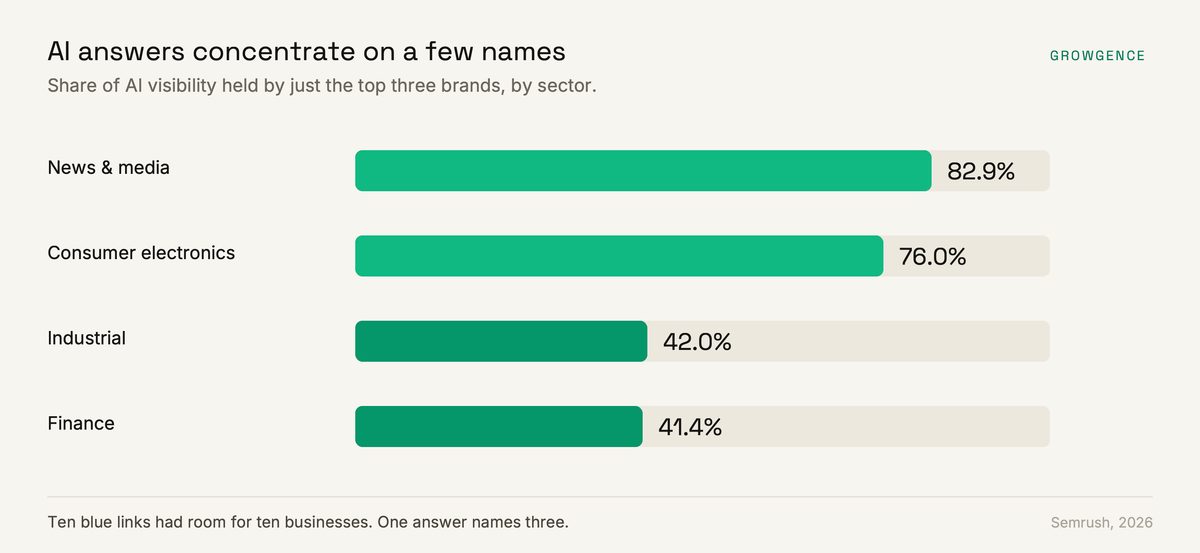
Share of AI visibility held by the top three brands: news and media 82.9%, consumer electronics 76%, industrial 42%, finance 41.4% (Semrush, 2026). Ten blue links had room for ten businesses; one AI answer names about three.
What is the honest answer: is this urgent or overhyped?
Most agencies stop before this part.
Today’s volume is small. Semrush analysed traffic across 50,000+ websites in 17 industries through 2025 and found AI traffic accounted for under 0.15% of total web visits, against 16.04% for organic search. AI traffic grew 66% year over year, but from a very low base (Semrush, 2026).
Nor is Google collapsing. Google stated in March 2025 that it sees “more than 5 trillion searches on Google annually” (Google, 2025). On the Q2 2026 earnings call, Pichai said Google is “sending billions of clicks to websites every week through AI features in Search” (Google, 2026). If you abandon conventional search visibility to chase AI, you are trading a large channel for a small one.
Measurement is also genuinely harder, because AI answers are not stable rankings. Whitespark’s guide to AI Mode for local businesses shows two users running the identical search from the same location and getting different results. Its conclusion: there is “no practical way to understand what each of your potential customers is being shown by AI Mode” (Whitespark, 2026). Anyone promising you a fixed “rank” inside ChatGPT is overselling.
The forecasts, meanwhile, are only forecasts. Semrush projects that AI search visitors could surpass traditional search visitors by early 2028 for the topics it studied. The same report explicitly notes these are extrapolations of historical data and adoption rates, not certainties (Semrush, 2026).
So the honest case is not “Google is dead.” It is narrower. The visitors are few but disproportionately valuable, the shortlist has fewer seats than a results page had, and claiming one of those seats costs less now than it will once every competitor in your category is trying. A Global Payments survey of 1,000 US small business owners found 78% already knew AI platforms could recommend their business. Just over half, 53%, were actively taking steps to appear in AI results, and another 22% planned to (Global Payments, 2026). The window where this is cheap is closing on its own.
What should a small business actually do first?
Do not restructure your marketing. Do four things in order.
- Find out where you stand. Ask the engines the ten questions your best customers actually ask before buying, and record whether you are named, cited, absent, or described incorrectly. That is the whole diagnostic. Our AI visibility audit framework walks through it step by step.
- Unblock the door. Check robots.txt and your CDN’s bot settings for GPTBot, OAI-SearchBot, PerplexityBot and Google-Extended. Decide deliberately which you allow, rather than inheriting a default.
- Make your facts unambiguous. Publish one consistent version of who you are, what you sell, where you operate, who you serve and what it costs. Keep it in text, on your own site, matching your listings. Engines name businesses they can describe confidently.
- Feed the sources engines read. Reviews and mentions on sites you do not own carry real weight here. In the Local SEO Data study, consumer-service businesses that appeared only in AI Mode had a median of 49% more reviews than those that appeared only in the Local Pack. Among plumbers the median gap was 337%, or 546 reviews against 125 (Local SEO Data, 2026). That is correlation, not proof that reviews cause AI visibility, but it points in an obvious direction. When Global Payments asked owners what drives AI visibility, 72% named customer reviews (Global Payments, 2026).
Which track you take next depends on your business. If your customers come from a defined geography, start with local AI visibility. If you sell nationally or across borders, start with global AI traffic.
Keep reading
- GEO vs traditional SEO: what changes when buyers ask AI. What carries over from your existing SEO and what does not.
- ChatGPT SEO: how to show up when buyers ask ChatGPT. The AI tool consumers named most, in detail.
- GEO for local and multi-location brands. Useful if your customers are geographic.
Sources
- Pew Research Center — Google users are less likely to click on links when an AI summary appears in the results (July 2025) — https://www.pewresearch.org/short-reads/2025/07/22/google-users-are-less-likely-to-click-on-links-when-an-ai-summary-appears-in-the-results/
- BrightLocal — Local Consumer Review Survey 2026 (AI trust findings) — https://www.brightlocal.com/research/lcrs-ai-trust/
- BrightLocal — Local Consumer Review Survey 2026 — https://www.brightlocal.com/research/local-consumer-review-survey/
- TechCrunch — OpenAI announces ChatGPT reaches 900M weekly active users (February 2026) — https://techcrunch.com/2026/02/27/chatgpt-reaches-900m-weekly-active-users
- Google — Alphabet earnings call Q2 2026, Sundar Pichai’s remarks — https://blog.google/company-news/inside-google/message-ceo/alphabet-earnings-q2-2026/
- TechCrunch — AI traffic to US retailers rose 393% in Q1 (Adobe Analytics data, April 2026) — https://techcrunch.com/2026/04/16/ai-traffic-to-us-retailers-rose-393-in-q1-and-its-boosting-their-revenue-too/
- Semrush — We Studied the Impact of AI Search on SEO Traffic — https://www.semrush.com/blog/ai-search-seo-traffic-study/
- Semrush — We analyzed billions of web visits: How AI is reshaping traffic channels — https://www.semrush.com/blog/traffic-channel-mix-study/
- Semrush — Expanded 2026 AI Visibility Index, analysing 126 million AI search prompts — https://www.semrush.com/news/463141-semrush-releases-expanded-2026-ai-visibility-index-analyzing-126-million-ai-search-prompts/
- Local SEO Data — study finds 28.5% of Local Pack businesses are invisible in Google AI Mode (May 2026) — https://www.prweb.com/releases/local-seo-data-study-finds-28-5-of-local-pack-businesses-are-invisible-in-google-ai-mode-302796340.html
- GatherUp — Beyond The Stars 2025: How American Consumers Use Reviews to Choose Local Businesses — https://go.gatherup.com/beyond-the-stars-2025
- OpenAI — Bots and crawlers documentation (OAI-SearchBot, GPTBot, ChatGPT-User) — https://developers.openai.com/api/docs/bots
- Cloudflare — Cloudflare Just Changed How AI Crawlers Scrape the Internet-at-Large (July 2025) — https://www.cloudflare.com/press/press-releases/2025/cloudflare-just-changed-how-ai-crawlers-scrape-the-internet-at-large/
- Google — AI, personalization and the future of shopping (March 2025) — https://blog.google/products/ads-commerce/ai-personalization-and-the-future-of-shopping/
- Global Payments small business AI survey, reported via Stacker/AOL (2026) — https://www.aol.com/articles/72-small-businesses-key-ai-190006361.html
- Whitespark — Guide to Google’s AI Mode for Local Businesses — https://whitespark.ca/guides/whitesparks-guide-to-googles-ai-mode-for-local-businesses/
Is your brand showing up when buyers ask AI?
Most owners have never checked, and the answer takes minutes to find. We will run a free AI visibility audit on your business, using the real questions your buyers ask across the engines they ask them in. You will see exactly where you are named, where you are absent, and what is fixable first.