AI Search vs Google Search: A Business Owner's Guide
Google finds and ranks pages you choose from. AI search reads them and writes one answer citing a few sources. Here is what actually changed, and what it means for you.
Google search finds pages, ranks them, and hands you links to choose from. AI search finds pages too, then reads them and writes one answer that cites only a handful of its sources. So on Google you compete for a position on a results page. In AI search you compete to be one of the few sources the answer is built from.
That difference does a lot of work.What is AI search, and how does it differ from Google search?
“AI search” means any tool that answers your question in writing instead of handing you a list of websites. Ask ChatGPT which accounting software suits a 20-person agency, or ask Perplexity to compare two suppliers. Read the written summary sitting at the top of a Google results page. All three of those count as AI search.
Google search, the blue-links version everyone grew up with, does something narrower. It does not answer your question. It finds pages that probably contain the answer, orders them by how good a match it thinks they are, and lets you decide where to click. Google gives you somewhere to look; AI search gives you the answer, then shows where it looked.
Why “Google versus AI” is the wrong frame
It is tempting to picture a fight between two companies. It isn’t one. Google shipped AI Overviews (the summary above the blue links) and AI Mode (a conversational search experience) into its own product. A single Google session can now hand a buyer a classic results page, an AI summary, or a chat-style answer. What you are comparing is two ways of producing an answer, not two brands. Both of them now run inside Google as well as outside it.
How does Google search actually work?
Google does three jobs, in order, and each one is a place where your business can quietly fall out of the process. Crawling is a program called Googlebot visiting your pages and reading them, the way a very fast, very literal visitor would. Indexing is Google storing what it found in an enormous searchable catalogue. Ranking is Google deciding, when someone searches, which pages from that catalogue to show and in what order.
If Googlebot cannot reach a page, that page is not in the catalogue. If it is not in the catalogue it cannot rank. If it does not rank near the top, it may as well not exist. Everything owners think of as SEO follows from that pipeline: the position earns the click, and the click brings the buyer to you. The whole system is built around handing the visitor over.
How does AI search actually work?
An AI assistant answers a question in three steps. Each one is a separate place where you can be included or left out.
Step 1: It rewrites your question
You ask a messy, human question. The system quietly turns it into several cleaner searches. Google calls its version “query fan-out”: “issuing multiple related searches concurrently across subtopics and multiple data sources and then brings those results together” (Google, 2025). Its site-owner documentation is more careful about how consistently this happens, saying AI Overviews and AI Mode “may use” the technique (Google Search Central). OpenAI describes comparable behaviour: “When ChatGPT search partners with other search providers, it typically rewrites your query into one or more targeted queries that it sends those providers” (OpenAI).
So the phrase your buyer typed is often not the phrase the system searched for. You compete not for their words but for the machine’s reading of them, several times over.
Step 2: It pulls a shortlist of sources
The system then fetches a small number of pages to work from. The vendors document part of where those pages come from.
OpenAI runs a crawler called OAI-SearchBot, “used to surface websites in search results in ChatGPT’s search features,” plus a ChatGPT-User agent for certain user actions rather than automatic crawling. On blocking the first, OpenAI is blunt: “Sites that are opted out of OAI-SearchBot will not be shown in ChatGPT search answers, though can still appear as navigational links.” ChatGPT search also draws on “third-party search providers, as well as content provided directly by our partners” (OpenAI). OpenAI never names those providers, so nobody outside the company can say which index a given answer drew on. Perplexity mirrors the pattern with PerplexityBot, “designed to surface and link websites in search results on Perplexity” (Perplexity).
Google runs no separate crawler and sets no separate entry requirement. To appear as a supporting link in AI Overviews or AI Mode, “a page must be indexed and eligible to be shown in Google Search with a snippet,” and there are “no additional technical requirements.” Even so, the two features “may use different models and techniques, so the set of responses and links they show will vary” (Google Search Central).
The distinction almost every owner gets wrong
An AI system can know about your company in two ways, and confusing them wastes money.
Training is the model reading an enormous archive of text at a fixed point in the past. What it absorbed is baked in until the model is retrained. That is why an assistant can confidently describe a company using two-year-old facts.
Retrieval is the system going and looking, right then, using the crawlers above. That is where citations come from, and it is the part you can influence on a normal business timescale. Retrieval decides who gets cited today; training shapes what the model says when it looks nothing up.
Step 3: It writes one answer and cites a few sources
A language model then reads the shortlist and composes a single answer in its own words, usually attaching a few source links. Pew Research Center found that among the Google searches in its study producing an AI summary, 88% of those summaries cited three or more sources, and only 1% cited a single source (Pew Research Center, 2025).
Three or more, then. But still a short list under a written answer, and there is no page two.
AI search vs Google search: what’s different at a glance?
Google Search (classic results page) | AI search (ChatGPT, Perplexity, Google AI Mode) | |
|---|---|---|
How it finds information | Crawls the web, indexes pages, ranks them against the query | Rewrites the question into several searches, then pulls a shortlist via its own crawler and, for ChatGPT, unnamed third-party providers |
How the answer is built | It isn’t. Google returns pages that may contain it | A language model reads the retrieved pages and writes one answer |
What the buyer sees | Around ten organic links, plus ads, maps and other blocks | One written answer with a handful of linked citations |
How many get named | Roughly ten per page, more on later pages | A short cited set, and no page two. 88% of Google AI summaries cited three or more sources (Pew, 2025) |
What “winning” means | Ranking high enough to earn the click | Being a source the answer is built from, described accurately |
Typical question | Short keywords: “crm software pricing” | Conversational: “which CRM works best for a 12-person B2B services firm” |
Where the buyer goes next | Clicks through to a website | Often finishes inside the assistant; may click a citation |
Main levers you control | Crawlability, relevance, links, page quality | Same fundamentals, plus quotable passages and corroboration elsewhere |
How you measure it | Rankings, impressions, clicks | Whether you are mentioned or cited, how often, how accurately |
What does this shift change about getting found?
Two things change, and neither of them needs new machinery.
The written answer names only a few options
On a results page, being fourth is survivable. In an AI answer, fourth is often invisible. The answer names a few options and moves on, and the buyer builds a shortlist without ever learning what was dropped.
The popular version of this argument overshoots, though. Google says that while an AI response is generated, its models “identify more supporting web pages, allowing us to display a wider and more diverse set of helpful links associated with the response than with a classic web search” (Google Search Central). The number of links on the surface is not necessarily shrinking. What is scarce is the number of businesses named inside the written answer, and that is the part the buyer actually reads. If a model recommends three competitors and skips you, you did not rank lower. You were left out of the sentence that forms the shortlist.
The click is no longer the only thing worth having
Pew Research Center tracked the real browsing of 900 US adults across 68,879 Google searches in March 2025. When an AI summary appeared, users clicked a traditional search result 8% of the time, against 15% when no summary was present. Only 1% clicked a link inside the summary itself (Pew Research Center, 2025).
The rest of the study complicates that. AI summaries appeared on only 18% of those searches, and Google’s documentation says AI Overviews show only when its systems judge them additive and “as such, often don’t trigger” (Google Search Central). Users were also likelier to end browsing entirely after a page with a summary, 26% versus 16%. That looks more like a satisfied reader than a stolen click. Google has since said it “increased the number of inline links directly within responses and added helpful website previews to encourage people to click through” (Google, 2026).
The lesson is narrower than “AI killed traffic.” Where a written answer appears, being named correctly inside it pays even when nobody clicks. That is where the shortlist forms.
Where do buyers actually go now, Google or AI?
They go to both, and the split follows the shape of the question rather than the age of the asker.
Classic search still owns the short ones. Navigational queries, where someone types your brand name to reach your site, still start in a search box. So do local ones like “dentist near me,” where maps are the fastest route to a phone number, and transactional ones where the buyer already knows the product name.
Assistants increasingly get the long ones. Open research goes to them, like “what’s the difference between a fractional CFO and an outsourced accountant,” and so does shortlisting, like “best project management tools for a design studio, and why.” Anything that carries more context than a keyword box can hold tends to end up in an assistant.
One measurable tell is question length. Google reports that “the average AI Mode search is triple the length of a traditional Search query” (Google, 2026). The pattern is not universal. A Semrush analysis of over 80 million lines of clickstream data from the second half of 2024 points the other way: ChatGPT prompts averaged 23 words when used conversationally, but 4.2 words once search was engaged (Semrush, 2025). That is a dated, single-platform study, so treat it as a direction rather than a benchmark.
Put the two together and you learn more than either gives you alone. When people want a link they type as they always did. When they want advice they type like they are talking to a person. The second kind of question decides who makes a shortlist.
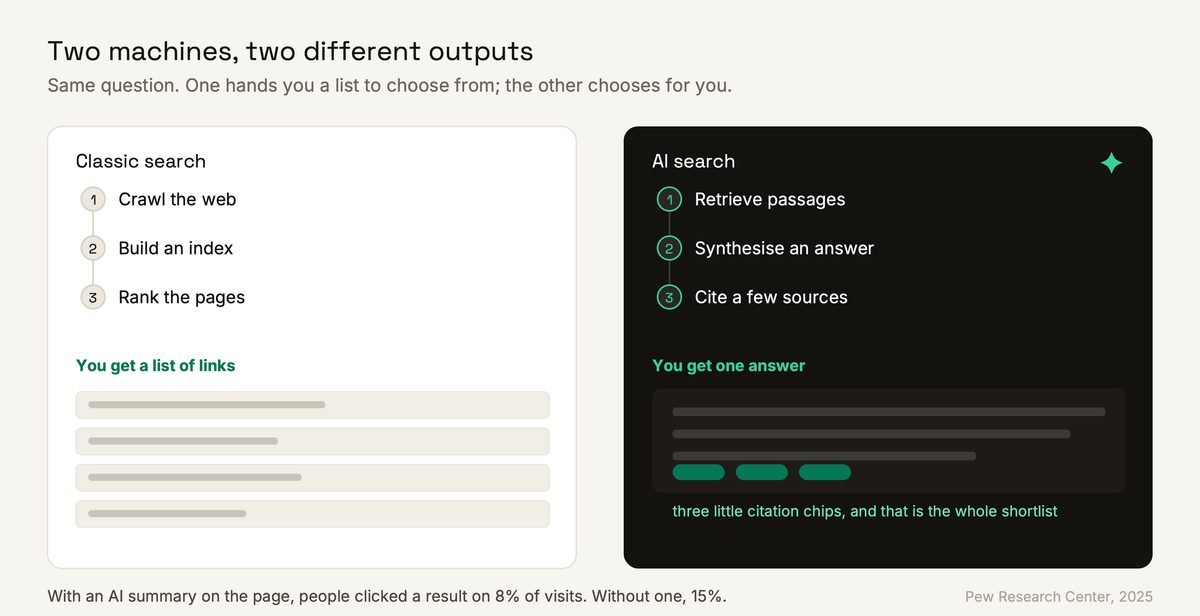
Classic search crawls, indexes and ranks, then hands you a list to choose from. AI search retrieves passages, synthesises one answer, and cites a handful of sources. When an AI summary appeared, people clicked a traditional result on 8% of visits, against 15% with no summary (Pew Research Center, 2025).
Is AI search replacing Google search? The honest answer
No, and planning as if it were will cost you money.
Statcounter recorded Google at 91.31% of worldwide search engine market share in July 2026 (Statcounter, 2026). Google’s own AI Mode has surpassed a billion monthly active users globally, with queries “more than doubled every quarter since launch” (Google, 2026). Both are true. Search did not move; it grew a second front. The adoption numbers deserve their own treatment, and they get one in do people use ChatGPT instead of Google?
So you cannot pick one. Abandon conventional search and you lose the buyers who still type four words into a box. Ignore AI answers and you lose the ones who ask a paragraph-long question, then take the first three names they are given.
A few more honest caveats, because this field attracts overclaiming.
Nobody can sell you a ranking in an AI answer. These systems are not deterministic: two people asking the same question on the same day can get different answers with different sources. Anyone quoting a guaranteed position is describing a product that does not exist. No vendor publishes how a given answer picked its sources either, so anyone describing those internals in detail is inferring.
There is no file, tag or shortcut that buys you in. Google’s documentation is unusually direct: “You don’t need to create new machine readable files, AI text files, or markup to appear in these features. There’s also no special schema.org structured data that you need to add” (Google Search Central). Structured data is worth having for reasons that predate AI. It is not a cheat code.
Measurement is harder, and results are not instant. Referral traffic from assistants is small, inconsistently labelled, and blind to an answer nobody clicked. Google now reports impressions and “information about which pages appear in AI responses” in Search Console (Google, 2026). Nothing equivalent exists elsewhere. Fixing what a system can retrieve about you is quick, since retrieval happens live; changing what a model believes unprompted waits on retraining.
One failure mode is self-inflicted. OpenAI states that sites opted out of OAI-SearchBot “will not be shown in ChatGPT search answers.” Perplexity recommends “allowing PerplexityBot in your site’s robots.txt file” so a site appears. Broad bot-blocking at a CDN or firewall can catch these agents alongside unwanted traffic, and checking costs nothing.
What should you actually do about it?
Nothing here requires a new department, just existing effort pointed at a different target.
- Confirm the AI crawlers can reach you. If the search crawler is blocked, no amount of good content gets cited.
- Stay properly indexed in conventional search. For Google’s AI features this is documented: a page must be indexed and snippet-eligible. For ChatGPT it is an informed hedge, since OpenAI confirms third-party search providers but not which ones.
- Answer the questions buyers actually ask, in their words. Long, situation-specific questions are what assistants get asked.
- Put a clear, self-contained answer near the top of each page. Machines lift short passages, not whole articles.
- Get named on sources others already trust, and keep your facts identical everywhere. Corroboration makes you safer to repeat; contradictory pricing makes you risky to quote.
- Measure mentions, not just rankings. Ask your buyers’ questions across the major systems and record whether you appear.
Being quotable is a writing discipline more than a technical one. Our GEO vs traditional SEO breakdown and the LLM SEO vs traditional SEO page cover that methodology. Platform-specific versions are here too: Google AI Overviews, Perplexity, ChatGPT. If you would rather start with a diagnosis, the AI visibility audit framework shows where you stand, and share of model turns that into a number.
Keep reading
- GEO vs Traditional SEO: What Changes When Buyers Ask AI — the methodology behind this shift.
- What Is LLM SEO? How to Get Cited by ChatGPT, Gemini and Perplexity — becoming a source assistants quote.
- How to Run an AI Visibility Audit — the framework for finding where you stand.
Sources
- Statcounter Global Stats, Search Engine Market Share Worldwide, July 2026 — https://gs.statcounter.com/search-engine-market-share
- Pew Research Center, Google users are less likely to click on links when an AI summary appears in the results, 22 July 2025 — https://www.pewresearch.org/short-reads/2025/07/22/google-users-are-less-likely-to-click-on-links-when-an-ai-summary-appears-in-the-results/
- Google, How AI Mode is changing and expanding the way people search, 19 May 2026 — https://blog.google/products-and-platforms/products/search/ai-mode-us-insights/
- Google, Expanding AI Overviews and introducing AI Mode, 5 March 2025 — https://blog.google/products-and-platforms/products/search/ai-mode-search/
- Google Search Central, AI features and your website — https://developers.google.com/search/docs/appearance/ai-features
- Google, New opportunities, control and insights for website owners, 3 June 2026 — https://blog.google/products-and-platforms/products/search/new-controls-website-owners/
- OpenAI, Bots (developer documentation) — https://developers.openai.com/api/docs/bots
- OpenAI Help Center, ChatGPT Search — https://help.openai.com/en/articles/9237897-chatgpt-search
- Perplexity, Perplexity Crawlers (developer documentation) — https://docs.perplexity.ai/guides/bots
- Semrush, New Semrush Study Reveals ChatGPT Search Trends: Insights from 80 Million Clickstream Records, 3 February 2025 — https://www.semrush.com/news/379285-new-semrush-study-reveals-chatgpt-search-trends-insights-from-80-million-clickstream-records/
Is your brand showing up when buyers ask AI?
Most owners have never checked, and the answer is rarely what they assume. Request a free AI visibility audit. We run your buyers’ questions across the major AI systems, then show you where you are named, where you are misdescribed, and where a competitor is recommended in your place.