Why Is My Business Not Showing Up in ChatGPT? 7 Reasons
Your business is missing from ChatGPT for one of two reasons: AI crawlers can't reach your site, or the web can't corroborate it. Here's how to diagnose and fix each.
Your business is not showing up in ChatGPT for one of two reasons: ChatGPT cannot reach your site (crawlers blocked at your CDN, firewall, or robots.txt), or it cannot corroborate what it finds (conflicting business facts across the web, no independent sources confirming you). Both are diagnosable in an afternoon, and most fixes cost nothing but time.
This matters more than it did a year ago. OpenAI said in February 2026 that ChatGPT had reached 900 million weekly active users (OpenAI via TechCrunch, 2026). More of them now ask it what they used to type into Google: “best accountant near me”, “is this brand legit”. Adobe Analytics measured a 1,200% jump in traffic reaching US retail sites from generative AI tools between July 2024 and February 2025. Those visitors browsed 12% more pages and had a 23% lower bounce rate than visitors from other channels, though they were also 9% less likely to convert (Adobe Analytics, 2025). Treat AI traffic as high-intent research, not free sales.One scope note. This post is about why you’re absent. Becoming the business ChatGPT recommends is a separate job, and we cover it in ChatGPT SEO: how to show up when buyers ask ChatGPT. Diagnose first: fixes aimed at the wrong problem waste months.
Here are the seven reasons, in the order you should check them:
# | Reason | 5-minute check | Fix |
|---|---|---|---|
1 | AI crawlers blocked at your CDN, firewall, or robots.txt | Read yourdomain.com/robots.txt; ask ChatGPT to open your homepage | Allow OAI-SearchBot and ChatGPT-User; review CDN bot settings |
2 | Not in the indexes ChatGPT can search | Check robots.txt for OAI-SearchBot; run site:yourdomain.com on Bing | Allow OAI-SearchBot and its IP ranges; set up Bing Webmaster Tools |
3 | Weak or contradictory entity footprint | Compare your name, description, and locations across your top 5 profiles | One canonical fact sheet, applied everywhere |
4 | No third-party corroboration | Search your brand with -site:yourdomain.com | Earn independent mentions: press, reviews, partner pages |
5 | Testing the wrong ChatGPT mode | Check whether the answer showed source links | Judge live-search visibility and training-data presence separately |
6 | Content AI can’t lift | Try to copy-paste a plain sentence stating what you do | Direct answers, clear headings, text not trapped in images |
7 | Outdated facts in the sources AI reads | Ask ChatGPT about your prices or hours, then open its cited sources | Correct the sources, not just your own site |
1. Is your website blocking AI crawlers without you knowing?
This is the most common technical cause, and the cruelest, because nobody chose it. A crawler is an automated program that reads web pages, and OpenAI publishes the ones it runs. Three matter. GPTBot crawls “content that may be used in training our generative AI foundation models”. OAI-SearchBot is used “to surface websites in search results in ChatGPT’s search features”. ChatGPT-User visits a page live when someone asks about it mid-conversation.
OpenAI is blunt about the consequence: “Sites that are opted out of OAI-SearchBot will not be shown in ChatGPT search answers.” It recommends two things together. Allow that crawler in robots.txt, and allow requests from its published IP ranges (OpenAI developer documentation). The IP half is what people miss.
Blocking often happens upstream of your website, at your CDN or firewall. A CDN (content delivery network) sits in front of your site to make it faster and shield it from attacks. Cloudflare is one of the largest, handling traffic for 20% of the web. On July 1, 2025 it changed its default to blocking AI crawlers on newly onboarded domains, after more than a million customers had already switched blocking on since 2024 (Cloudflare, 2025). If your site was set up on a default plan in that window, there’s a fair chance ChatGPT cannot read it.
The 2026 picture is narrower, which is good news. Cloudflare now sorts AI bots into three groups: Search, Agent and Training. From September 15, 2026 its defaults for new domains block Training and Agent only on ad-carrying pages, and let Search bots through (Cloudflare, 2026). If your site carries no advertising, those defaults shouldn’t stand in ChatGPT’s way. The risk sits with domains onboarded under the older blanket default, and with settings your web person chose by hand.
The 5-minute check
Open yourdomain.com/robots.txt in a browser. This public file tells crawlers what they may read. Look for User-agent: GPTBot or User-agent: OAI-SearchBot followed by Disallow: /. That combination means “stay out.” Then ask ChatGPT to open your homepage URL and summarise it. If it can’t, something between ChatGPT and your site is refusing the connection: robots.txt, your CDN’s bot settings, or your firewall.
The fix
Decide your policy deliberately. At minimum, allow OAI-SearchBot so you’re eligible for ChatGPT’s search answers, and ChatGPT-User so live fetches work. GPTBot is a separate decision: allowing it means your content can inform future model training. Then ask whoever manages your CDN to review its AI-bot and IP-level rules. A robots.txt fix does nothing if the request is refused before your site ever sees it.
2. Can ChatGPT’s search find you at all?
Owners assume ChatGPT sees whatever Google sees. It doesn’t, and ranking well on Google is no guarantee of appearing in a ChatGPT answer. The one lever OpenAI documents publicly is the one from reason 1: OAI-SearchBot has to be allowed to crawl you, or your pages aren’t eligible for its search answers.
Bing deserves a paragraph because it’s the search engine most often named here. In May 2023, Microsoft announced it was “bringing Bing to ChatGPT as the default search experience” (Microsoft Bing Blog, 2023). That announcement is where the widely repeated claim that Bing is ChatGPT’s index comes from. What hasn’t happened since is a current, definitive account from OpenAI of which external providers it uses and in what proportion. OpenAI also runs its own search crawler now. So the honest position: Bing indexing is a cheap hedge rather than a master switch, and it certainly governs whether Microsoft Copilot can find you. Being crawlable by OAI-SearchBot is the documented requirement. Do both, and distrust anyone claiming to know the exact recipe.
The 5-minute check
Search site:yourdomain.com on bing.com, which shows the pages of your site Bing knows about. The count is approximate, so read it as a rough signal. A 60-page website returning four results has a Bing problem. Then re-check robots.txt for OAI-SearchBot, the constraint OpenAI actually documents.
The fix
Set up Bing Webmaster Tools. It’s free. If you already use Google Search Console, you can import your verified sites straight across and skip manual verification (Bing Webmaster Blog). Submit your sitemap, then work through anything Bing flags as a crawl error. Unglamorous work most competitors skip, which is why it’s worth an hour.
3. Does the web agree on the basic facts about your business?
AI systems don’t look you up in a single directory. They assemble a picture of you as an entity: a distinct thing with a name, a category, locations, and relationships. That picture is stitched from your website, your Google Business Profile, LinkedIn, industry platforms, and anywhere else you appear. Those sources often disagree, though: three different business names, an old address on one profile, “marketing agency” here and “software company” there. The result is a blurry picture, and a blurry picture is a weak basis for a recommendation.
The 5-minute check
Open your five most important profiles side by side: your About page, Google Business Profile, LinkedIn, and the top two platforms for your industry. Compare business name, one-line description, category, and locations. Then ask ChatGPT: “What do you know about [business name] in [city]?” Wrong or missing answers show what the assembled picture looks like today.
The fix
Write one canonical fact sheet: exact name, one-sentence description in plain language, category, locations, key services. Apply it everywhere, starting with your About page. You don’t need your name sprayed across fifty directories. You need the handful of sources AI actually reads to agree with each other. We go deeper in Entity SEO: building the authority AI trusts.
4. Is anyone besides you talking about your business?
Every business says it’s excellent. A claim that appears only on your own website gives an assistant nothing to weigh it against. When assistants name specific businesses, they lean on what shows up in more than one place: independent sites that mention you, review platforms with a real history, press coverage, partner and supplier pages, community discussion. With no corroboration, there’s nothing to confirm. Businesses with nothing to confirm get left out even when their site is technically perfect.
The 5-minute check
Search your business name on Bing or Google with -site:yourdomain.com appended. The minus sign excludes your own site, so what remains is what the rest of the web says about you. If the results are just your own social profiles, you’ve found the problem. Two or three substantive independent mentions is a start. If a competitor has twenty and you have none, expect to be the one skipped.
The fix
Earn mentions, gradually and for real. Realistic starting points: the trade publications your customers read, local press, and reviews on the one or two platforms that dominate your industry. The partner pages of businesses you already work with are worth asking about too. Slower than any technical fix here, and it compounds more. Our guide to digital PR for AI citations covers how to do it without a PR agency retainer.
5. Are you testing the wrong ChatGPT mode?
ChatGPT answers in two ways, and owners routinely diagnose the wrong one. Without web search, it answers from training data: the snapshot of the web its model learned from, frozen at a knowledge cutoff months before you asked. With web search (triggered automatically for many queries, or when you toggle it on), it fetches live pages and cites them. A small or young business absent from training data is normal, not a verdict. Plenty of long-established businesses aren’t in there either.
The 5-minute check
Look at the answer that worried you. Did it include source links? If yes, that was live search, and reasons 1, 2 and 6 are your levers. If not, the answer came from frozen training data. No fix you ship this quarter will change what an already-trained model says. Run the test both ways: once as a plain question, once with “search the web for…” in front.
The fix
Mostly, fix your expectations and priorities. Live-search visibility responds to the plumbing repairs in reasons 1 and 2, so start there. Training-data presence follows slowly from reasons 3 and 4: as your entity footprint and independent mentions accumulate, later model versions have more to absorb. You can’t shortcut the second clock, but you can start it.
6. Can ChatGPT actually lift an answer from your site?
When ChatGPT searches, it doesn’t display your homepage. It extracts sentences and facts to compose an answer. Sites lose here in two ways. The first is thin content: a homepage saying “Innovative solutions for the modern enterprise” gives an AI nothing to quote. The second is structure: text embedded in images and sliders, vague headings, key details buried in paragraph seven. Ask what a rushed stranger could extract from your site in ten seconds. That’s roughly what an AI gets.
The 5-minute check
Open your most important page and try to select and copy one plain sentence stating what you do, for whom, where, and at what rough price. If you can’t find one, or the text can’t be selected because it’s part of an image, you’ve found the problem. Second test: ask ChatGPT to open that URL and say what the business offers and who it’s for.
The fix
Give every important page one direct, quotable answer near the top. Then use headings phrased the way buyers ask questions, with concise answers underneath. An FAQ built from your real sales conversations is the cheapest liftable content there is. Then add schema markup: structured code that labels your pages for machines. It says “this is our name, these are our hours, this is a service and its price.” Our schema markup for AI search guide has copy-paste templates.
7. Is ChatGPT repeating old or wrong facts about you?
Sometimes ChatGPT does mention you, and gets you wrong. It may describe your business accurately as of 2022: the old location, discontinued services, prices from two rebrands ago. Both channels do this: training data preserves whatever the web said when the snapshot was taken, and live search is only as good as the pages it retrieves. If the top sources about you are a stale directory listing and a five-year-old article, the AI repeats their errors faithfully.
The 5-minute check
Ask ChatGPT, with search on, specific factual questions: “What does [business] charge?” “Where is [business] located?” “What services does [business] offer?” Then note which sources it cites and open each one to check the facts against reality. This audits your paper trail. The AI is only reading it back to you.
The fix
Correct at the source. Update, or request corrections to, the pages ChatGPT cites: the directory profile, the outdated article, the old listing. On your own site, state current facts explicitly and keep visible “last updated” dates where facts change, like pricing and locations. One caution: don’t answer stale facts elsewhere by deleting your own history pages. Fewer sources make reason 3’s blurry-picture problem worse.
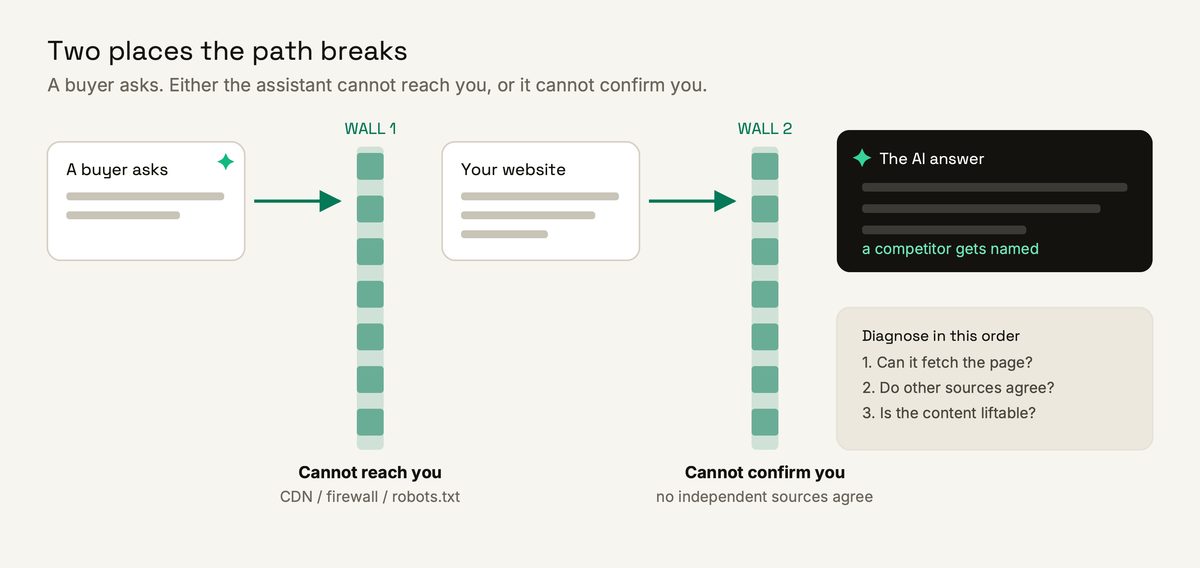
The two failure points. Wall 1 is technical: crawlers blocked at your CDN, firewall or robots.txt. Wall 2 is reputational: no independent sources confirm who you are. Check them in that order.
How long until ChatGPT starts mentioning you? (The honest answer)
There’s no switch anyone can flip, including an agency: no submission form for ChatGPT’s organic recommendations, and no way to buy in. Paid placement is a separate, labelled surface. OpenAI runs a distinct crawler, OAI-AdsBot, to “validate the safety of web pages submitted as ads on ChatGPT” (OpenAI developer documentation). Ads are ads. The organic recommendation you’re chasing sits on a different surface.
What you control is how reachable and how corroborated your business is, and the two run on different clocks. Our working expectation is this, and it is an expectation rather than a measured benchmark. Plumbing fixes surface in live-search answers fastest, in days to weeks. Entity consistency and corroboration build over months. Training-data presence moves slowest, and it arrives only when new model versions ship. Anyone quoting a guaranteed timeline is guessing.
Expect fuzziness in measurement too, because ChatGPT’s answers vary between sessions and phrasings and a single test proves little. Test a fixed panel of buyer questions on a regular schedule and watch the trend. Payoff is uneven as well: a business in a crowded generic category (“marketing agency London”) fights much harder for a mention than one with a specific niche and a distinct name. If you’re reachable, indexed, consistent and corroborated and the mentions still haven’t come, the problem is usually competitive rather than technical. That one needs a strategy conversation.
These seven checks are cheap, they rule out the causes that are actually fixable, and none of them requires a developer.
Keep reading
- How to run an AI visibility audit: the full framework. Turn today’s checks into a repeatable monthly audit.
- What is share of model? The AI visibility metric explained. How to measure whether these fixes are working.
- GEO vs traditional SEO: what changes when buyers ask AI. Where your existing SEO still helps, and where it doesn’t.
Sources
- Cloudflare press release — Cloudflare Just Changed How AI Crawlers Scrape the Internet-at-Large (July 1, 2025) — https://www.cloudflare.com/press/press-releases/2025/cloudflare-just-changed-how-ai-crawlers-scrape-the-internet-at-large/
- Cloudflare blog — Content Independence Day: no AI crawl without compensation! (July 1, 2025) — https://blog.cloudflare.com/content-independence-day-no-ai-crawl-without-compensation/
- Cloudflare blog — Your site, your rules: new AI traffic options for all customers (July 1, 2026) — https://blog.cloudflare.com/content-independence-day-ai-options/
- OpenAI developer documentation — Overview of OpenAI crawlers (GPTBot, OAI-SearchBot, ChatGPT-User, OAI-AdsBot) — https://developers.openai.com/api/docs/bots
- TechCrunch — ChatGPT reaches 900M weekly active users (OpenAI announcement, February 27, 2026) — https://techcrunch.com/2026/02/27/chatgpt-reaches-900m-weekly-active-users
- Adobe Analytics — Traffic to U.S. retail websites from generative AI sources jumps 1,200 percent (March 17, 2025) — https://blog.adobe.com/en/publish/2025/03/17/adobe-analytics-traffic-to-us-retail-websites-from-generative-ai-sources-jumps-1200-percent
- Microsoft Bing Blog — Bing at Microsoft Build 2023 (Bing brought to ChatGPT as the default search experience) — https://blogs.bing.com/search/may\_2023/Bing-at-Microsoft-Build-2023
- Bing Webmaster Blog — Import sites from Search Console to Bing Webmaster Tools — https://blogs.bing.com/webmaster/september-2019/Import-sites-from-Search-Console-to-Bing-Webmaster-Tools
Is your brand showing up when buyers ask AI?
If you’d rather not run these checks yourself, we will. Our free AI visibility audit tests how ChatGPT, Perplexity and Google’s AI actually answer your buyers’ questions. It shows which of these seven problems is standing in your way.