What Does GEO Mean in Marketing? (Not Geofencing)
In marketing, GEO means generative engine optimization — getting ChatGPT, AI Overviews, Gemini and Perplexity to name and cite your business. It is not geofencing.
In marketing, GEO means generative engine optimization: getting AI answer engines such as ChatGPT, Google AI Overviews, Gemini and Perplexity to name, recommend and cite your business when a buyer asks them a question you should win. It has nothing to do with geofencing or location targeting, despite the shared three letters.
That is the whole answer. The rest explains where the term came from, how to tell it apart from the location “geo” words you already use, why it started mattering to revenue, and what the work actually involves.What does GEO stand for in marketing?
GEO stands for generative engine optimization.
Break the phrase into three plain words and it explains itself:
- Generative means the software writes an answer rather than handing you a list of links.
- Engine means the system doing the answering: ChatGPT, Gemini, Perplexity, Copilot, or the AI summary sitting at the top of a Google results page.
- Optimization means the work you do so that system picks your business as part of its answer.
GEO meaning in marketing: the short version
If someone in a meeting says “we need to think about GEO,” they are asking one thing. When our buyers stop typing keywords into a search box and start asking an AI assistant for a recommendation, does our name come out of its mouth?
The term is not an agency invention. It comes from a paper titled “GEO: Generative Engine Optimization,” published at the ACM SIGKDD conference in 2024. The authors were researchers from Princeton University, the Indian Institute of Technology Delhi, Georgia Tech and the Allen Institute for AI. They defined “generative engines” as systems that retrieve documents and then use large language models to write a grounded, cited response. Then they tested whether rewriting a source could lift its visibility inside those answers. The right changes lifted it by up to 40% (Aggarwal et al., KDD 2024).
You will also hear the same idea called AI search optimization, answer engine optimization (AEO) or LLM SEO. The labels compete. The job underneath does not. For the mechanics of the citation side specifically, we cover it in what LLM SEO is and how to get cited.
Doesn’t GEO mean geofencing or geo-targeting?
This is the biggest source of confusion about GEO in marketing, and it is a fair one. For years, “geo” in a marketing meeting meant location. Media buyers still say “which geos are we running in?” when they mean countries and cities. So when a supplier emails you about “GEO,” the first job is to work out which conversation you are in.
Term | What it actually means | What it is about | Where you hear it |
|---|---|---|---|
GEO (generative engine optimization) | Getting your business named and cited inside AI-written answers | Visibility in AI answers | AI search, SEO and content teams |
Geofencing | Drawing a virtual boundary on a map and triggering ads or notifications when a phone crosses it | Ad delivery by physical location | Mobile and programmatic advertising |
Geo-targeting | Serving different ads, prices or page content based on a visitor’s country, region, city or IP address | Ad and website personalization | Paid search, paid social, CRO |
Geomarketing | Using mapping and location data to choose store sites, set sales territories and plan local campaigns | Location strategy and analytics | Retail, franchise and field sales |
“Geo” as a campaign setting | Literally the location field inside Google Ads or Meta Ads | A targeting setting | Media buying |
The overlap that trips people up
One place the two meanings genuinely touch: if you run a restaurant, clinic or dealership, buyers now ask AI assistants location-shaped questions. “Best physiotherapist near Bandra.” “Which accountants in Leeds handle e-commerce VAT.” Answering those well is generative engine optimization applied to a local business, not geofencing. We treat it as its own discipline in local AI visibility. The evidence AI systems lean on for local answers (profiles, reviews, directory consistency) is not the evidence they use nationally.
What is GEO in digital marketing, in plain English?
The old journey: your customer types a phrase into Google, sees ten blue links, clicks two or three, and forms a shortlist. Your job was to be one of those links.
The new journey: your customer asks a full question, and an assistant reads sources and writes back a single paragraph of recommendation, sometimes with a few small citation markers. They may never see a list of links at all.
In the old world you competed for a position. In the new world you compete to be part of the sentence.
GEO is the work that makes you part of the sentence. Concretely, that means four things:
- Being reachable. The AI systems have to be able to fetch your pages at all.
- Being quotable. Your pages have to contain short, clear, self-contained statements a machine can lift without mangling them.
- Being corroborated. Independent sources the models trust have to say similar things about you.
- Being unambiguous. The systems have to understand exactly who you are, what you sell and who you serve, without guessing.
There is no GEO account to open and no GEO budget to bid with. That surprises most owners.
Why does GEO matter for my business now?
Because the audience stopped being niche.
- Google’s AI Overviews, the AI summary above the traditional results, have over 2.5 billion users each month (Alphabet investor presentation, June 2026).
- Google’s conversational AI Mode passed 1 billion monthly active users after its global rollout, and the Gemini app reports 950 million monthly active users (Alphabet Q2 2026 earnings remarks).
- ChatGPT reached 900 million weekly active users in OpenAI’s February 2026 announcement, the most recent figure the company has published (OpenAI, 2026).
- Perplexity’s chief executive said the product handled 780 million queries in a single month in May 2025, still the last volume figure the company has disclosed publicly (TechCrunch, 2025).
Those are not early-adopter numbers. That is your customer base.
The part that costs you money
Volume alone would not matter if AI answers still sent people to your website. Increasingly, they do not.
The Pew Research Center tracked the browsing of 900 US adults who agreed to share it, across 68,879 Google searches in March 2025. When an AI summary appeared, users clicked a traditional search result on 8% of visits. With no AI summary, they clicked on 15%, nearly twice as often. Only 1% of visits produced a click on a link inside the AI summary itself. Users also ended their browsing session entirely on 26% of pages with an AI summary, against 16% of pages without one (Pew Research Center, 2025).
In owner language: the ranking you paid for still exists, but fewer people travel down to it. The summary satisfied them first. If it did not mention you, the shortlist formed without you, and you will never see that loss in your analytics. There is no line item called “excluded from the answer.”
The upside, and it is real
The visitors who do arrive from AI tools are unusually far along. Semrush studied more than 500 topics and compared AI search visitors, tracked from a non-Google AI source such as ChatGPT, against ordinary organic visits. Measured by conversion rate, the AI visitor is 4.4 times as valuable (Semrush, 2025). The assistant has already done the comparing before the person lands on you.
Adobe’s analysis of US retail sites pointed the same way on engagement. Visitors from generative AI sources were 8% more engaged, viewed 12% more pages per visit, and bounced 23% less often than other traffic (Adobe Analytics, 2025).
Fewer visits, better visits. That is the trade the AI era is offering. GEO is how you make sure you are on the receiving end of it.
What does GEO work actually look like day to day?
Less exotic than the acronym suggests. Seven workstreams cover most of it.
Workstream | The owner’s question it answers | What it looks like in practice |
|---|---|---|
Access | Can AI systems read my site at all? | Audit robots.txt, CDN bot rules and firewall settings for blanket blocks on AI crawlers |
Baseline | Where do we stand today? | Ask the real questions your buyers ask, across several assistants, and record whether you are named, cited or absent |
Answer-shaped content | Does the page answer the question directly? | Lead with a short, self-contained answer; add specifics, comparisons and tables underneath |
Entity clarity | Do the models know who we are? | Make your name, category, location and description consistent across your site and every external profile |
Third-party evidence | Does anyone independent back the claim? | Earn mentions in reviews, roundups, trade press and community threads |
Structured data | Can machines parse the facts? | Schema markup for organization, services, products and FAQs |
Tracking | Is it working? | Re-run the same prompt set on a schedule and watch the trend |
The access problem nobody expects
The first row deserves a warning. It silently disqualifies businesses that are doing everything else right.
AI answer engines use named crawlers, and blocking the wrong one has consequences the marketing team never sees. OpenAI’s documentation lists four. GPTBot handles model training, ChatGPT-User covers actions a person triggers, and OAI-AdsBot checks ad landing pages. The fourth is OAI-SearchBot, which OpenAI describes as “used to surface websites in search results in ChatGPT’s search features.” The docs are blunt about the consequence of blocking it: “sites that are opted out of OAI-SearchBot will not be shown in ChatGPT search answers, though can still appear as navigational links” (OpenAI developer documentation).
Many sites block these bots without anyone deciding to: a default bot-management setting at the CDN, an over-broad security rule, or a robots.txt line copied from a template. Checking takes minutes. Discovering it after a year of wondering why AI never mentions you is expensive.
How is GEO different from the SEO I already pay for?
They overlap more than either camp admits, and less than “just do good SEO” implies. The full comparison is in GEO vs traditional SEO.
Google is explicit about its own surfaces. Its guidance on AI features says there are “no additional requirements to appear in AI Overviews or AI Mode, nor other special optimizations necessary.” It adds that “you don’t need to create new machine readable files, AI text files, or markup to appear in these features” (Google Search Central). For Google, the entry ticket is being indexed and eligible for a snippet.
But Google is one engine. ChatGPT and Perplexity run their own crawlers and retrieval, and they lean on evidence that lives off your website: forums, review platforms, comparison articles, trade coverage. That is where the disciplines separate. Traditional SEO optimizes a page to be ranked. GEO optimizes a claim to be repeated.
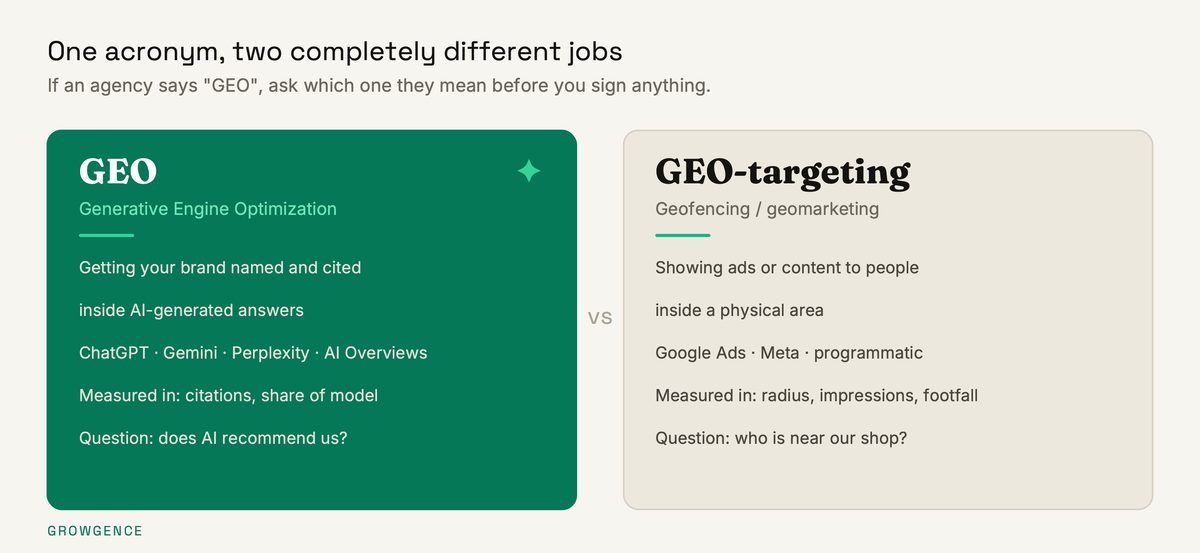
The same three letters do two unrelated jobs. Generative Engine Optimization is about being named inside AI answers and is measured in citations and share of model. Geo-targeting is about reaching people inside a physical area and is measured in radius, impressions and footfall.
What’s the honest answer about what GEO can’t do?
Three things, and any supplier who skips them is selling you something.
One: nobody can guarantee a citation. Generative engines are probabilistic. Ask the same question twice and you can get two different sets of sources. There is no submission form and no ranking report that promises inclusion. You can improve the odds systematically, then measure across many prompts rather than obsessing over any single answer.
Two: the evidence on commercial return is still forming. Semrush’s 4.4x conversion figure is genuinely encouraging (Semrush, 2025). But the same Adobe research that found AI visitors more engaged also found them, in February 2025, still 9% less likely to convert than other sources. That gap had closed sharply from 43% the previous July (Adobe Analytics, 2025). Both are real measurements of different populations at different moments. The honest reading is that AI traffic is small, growing fast and improving in quality. It is not a guaranteed windfall.
Three: the traffic economics are lopsided by design. Cloudflare measured how many times AI companies crawl the web for every visitor they send back. In July 2025 the ratio was roughly 38,000 crawls per referral for Anthropic, around 1,091 for OpenAI, and about 5.4 for Google. Across a twelve-month window, 80% of AI crawling was for training and only 18% for search (Cloudflare, 2025). These systems read far more than they refer. Judge GEO on mentions, recommendations and pipeline quality, not only on a traffic graph.
One more caveat. You will be pitched quick fixes, and llms.txt files are the most common. It is a proposed standard, not an adopted one, and Google has said no such file is required for its AI features. We assessed the evidence in our llms.txt guide instead of repeating the pitch.
How do I tell whether I have a GEO problem?
You do not need a tool to find out whether the problem exists. Take fifteen minutes and do this yourself.
- Write down five questions a real buyer asks before choosing you. Not your brand name. The problem in their words: “how much does commercial pest control cost in Chicago,” “best payroll software for a 30-person agency.”
- Ask each one in ChatGPT, Google AI Mode and Perplexity. Use plain sentences, the way a customer would. Score each answer three ways: were you named, cited with a link, or absent?
- Note who did appear. Competitors, directories, review sites, a Reddit thread. That list tells you where the models are getting their evidence.
- Ask your brand name directly. “What is [your company]?” If the description is thin, wrong or confused with another business, you have an entity problem before you have a content problem.
If you are absent from most of the five, that is your answer. Appearing inconsistently means you have a foothold worth defending. This is a smoke test, not a diagnosis. The repeatable method, with prompt sets and scoring, is in how to run an AI visibility audit. Tracking the pattern over time has a name: share of model.
Keep reading
- GEO vs traditional SEO: what changes when buyers ask AI
- How to run an AI visibility audit: a practical framework
- How to rank in Google AI Overviews
Sources
- Aggarwal, P., Murahari, V., Rajpurohit, T., Kalyan, A., Narasimhan, K., Deshpande, A. “GEO: Generative Engine Optimization,” KDD ’24. https://arxiv.org/abs/2311.09735
- Alphabet investor presentation, 3 June 2026. https://blog.google/alphabet/investor-presentation-june-2026/
- Alphabet Q2 2026 earnings, CEO remarks, 22 July 2026. https://blog.google/company-news/inside-google/message-ceo/alphabet-earnings-q2-2026/
- TechCrunch, “ChatGPT reaches 900M weekly active users,” 27 February 2026. https://techcrunch.com/2026/02/27/chatgpt-reaches-900m-weekly-active-users
- OpenAI, “Scaling AI for everyone,” February 2026. https://openai.com/index/scaling-ai-for-everyone/
- Pew Research Center, “Google users are less likely to click on links when an AI summary appears in the results,” 22 July 2025. https://www.pewresearch.org/short-reads/2025/07/22/google-users-are-less-likely-to-click-on-links-when-an-ai-summary-appears-in-the-results/
- Semrush, “We Studied the Impact of AI Search on SEO Traffic,” 21 July 2025. https://www.semrush.com/blog/ai-search-seo-traffic-study/
- Adobe, “Adobe Analytics: Traffic to U.S. retail websites from generative AI sources jumps 1,200 percent,” 17 March 2025. https://blog.adobe.com/en/publish/2025/03/17/adobe-analytics-traffic-to-us-retail-websites-from-generative-ai-sources-jumps-1200-percent
- Cloudflare, “The crawl-to-click gap: Cloudflare data on AI bots, training, and referrals,” 29 August 2025. https://blog.cloudflare.com/crawlers-click-ai-bots-training/
- OpenAI developer documentation, “Bots”. https://developers.openai.com/api/docs/bots
- Google Search Central, “AI features and your website”. https://developers.google.com/search/docs/appearance/ai-features
- TechCrunch, “Perplexity received 780 million queries last month, CEO says,” 5 June 2025. https://techcrunch.com/2025/06/05/perplexity-received-780-million-queries-last-month-ceo-says
Is your brand showing up when buyers ask AI?
We will run a free AI visibility audit on your business. We ask the real questions your buyers ask, across the major AI engines, then send you a plain-English report: where you are named, where you are absent, and what is causing it. No obligation to work with us afterwards.